Media
ITK Inhibitor Soquelitinib Shows Promising Clinical Data, Poised to Become the Strongest Competitor to "Immunology Drug King" Dupixent
Data from Cohort 4 of the U.S. Phase 1 clinical trial of the ITK inhibitor soquelitinib (CPI-818) in moderate-to-severe atopic dermatitis were released on the evening of January 20, Beijing time. Compared with the 4-week treatment duration in Cohorts 1–3, the 8-week treatment showed more robust efficacy and safety results: 75% of patients achieved EASI 75, 25% achieved EASI 90, and 33% achieved IGA 0/1. In patients previously treated with Dupixent (dupilumab) and JAK inhibitors, 60% achieved EASI 75. These breakthrough data indicate that soquelitinib has the potential to become an important new first-line therapy for patients with moderate-to-severe atopic dermatitis. Leveraging its differentiated advantages of "upstream intervention, oral administration, and efficacy in refractory patients," soquelitinib is expected to become the strongest competitor to the current "immunology drug king" Dupixent.
Angel Pharmaceuticals holds the rights to soquelitinib in Greater China. The company has recently initiated a Phase 1b/2 clinical trial in China for moderate-to-severe atopic dermatitis. This Phase 1b/2 trial will build on the positive results from the U.S. Phase 1 clinical trial conducted by Corvus Pharmaceuticals (CRVS), investigating longer treatment durations (12-week treatment period) and additional dose options.
To date, preclinical and clinical study results for soquelitinib support the novel mechanistic hypothesis that inhibiting ITK acts upstream to modulate multiple T-cell functional pathways. The immune rebalancing effects demonstrated thus far suggest potential across a wide range of inflammatory and immune-mediated diseases. Angel Pharmaceuticals is developing soquelitinib for multiple indications.
Data from Cohort 4 of the Phase 1 Clinical Trial in Atopic Dermatitis
As of January 15, 2026, enrollment in Cohort 4 was complete, and all soquelitinib-treated patients (n=12) had completed the 56-day treatment course. Of the 12 enrolled placebo patients, 10 were evaluable at Day 56, as 2 patients missed the Day 56 visit; both patients completed unscheduled follow-up visits at later time points.
Patients in Cohort 4 had baseline characteristics similar to those in Cohort 3. Compared with Cohorts 1 and 2, patients in these cohorts had more severe disease, with higher mean baseline EASI (Eczema Area and Severity Index) scores. In Cohort 4, the mean baseline EASI was 25.7 for soquelitinib-treated patients and 21.9 for placebo-treated patients.
Figure 1 summarizes the efficacy results for EASI 75, EASI 90, and IGA 0/1 across Cohorts 1 through 4. The results for Cohorts 3 and 4 appeared similar, but Cohort 4 showed higher proportions achieving EASI 75 and EASI 90. For Cohort 4, 75%, 25%, and 33% of soquelitinib-treated patients achieved EASI 75, EASI 90, and IGA 0/1, respectively, compared with 20%, 0%, and 0% in the placebo group.Figure 1: Percentage of Patients Achieving EASI 75, EASI 90, and IGA 0 or 1 at Day 28 (Cohorts 1–3) or Day 56 (Cohort 4)
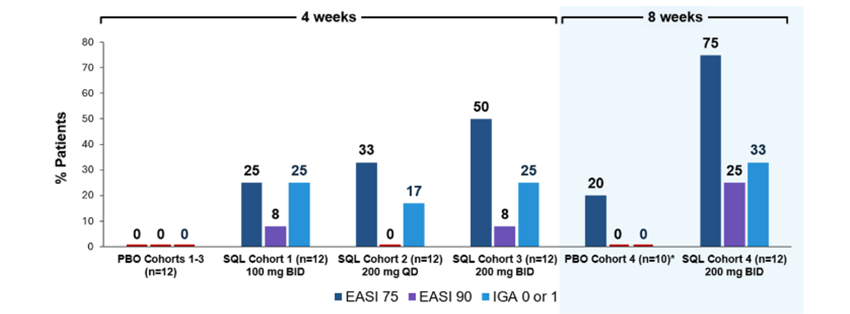
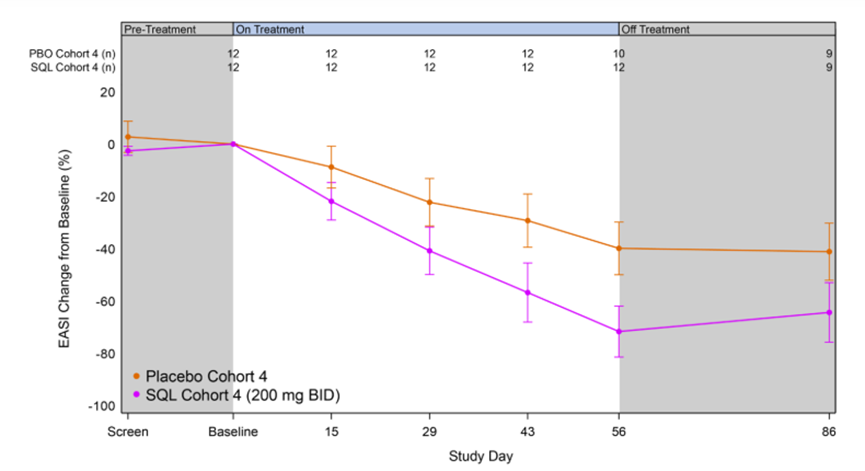
Figure 2 shows the response kinetics for soquelitinib- and placebo-treated patients in Cohort 4. The curves separated as early as the first visit (Day 15) and continued to increase through Day 56. The Day 56 results were statistically significant, with p=0.035. Disease control was maintained during the follow-up period after 30 days of treatment.Figure 2: Mean Percentage Reduction in EASI for Cohort 4
Figures 3A and 3B show response curves for soquelitinib- and placebo-treated patients across all Cohorts 1–4 and for Cohorts 3–4 only, with subgroup analyses based on prior systemic therapy history. Across all four cohorts, 25 patients (35% of all patients) had received prior systemic therapy, with dupilumab being the most common prior systemic therapy (n=11). Other prior systemic therapies included JAK inhibitors, corticosteroids, and investigational drugs. Regardless of prior systemic therapy history, the response curves for soquelitinib-treated patients were broadly similar. Placebo patients with prior systemic therapy experience showed smaller EASI reductions compared with systemic therapy-naïve placebo patients. These results demonstrate that soquelitinib has similar activity in both systemic therapy-naïve and experienced patients. Additionally, patients with prior systemic therapy experience appeared to have more severe disease. The two placebo patients who achieved EASI 75 were systemic therapy-naïve. None of the seven placebo patients with prior systemic therapy experience achieved EASI 75 or EASI 50; among the five soquelitinib-treated patients with prior systemic therapy experience, three achieved EASI 75.Figure 3: Mean Percentage Reduction in EASI for Cohorts 1–4 – Subgrouped by Prior Systemic Therapy Status
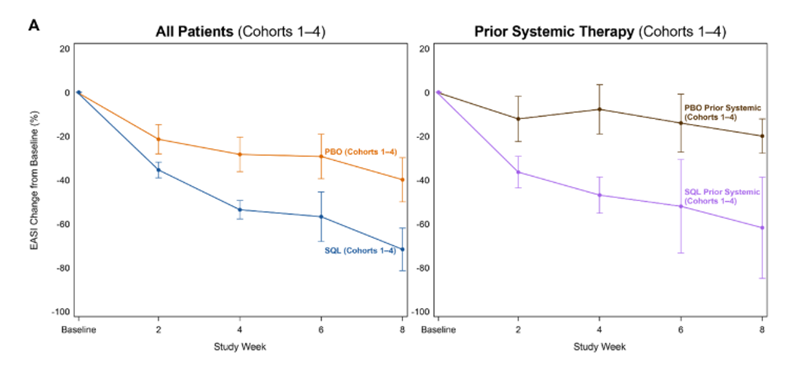
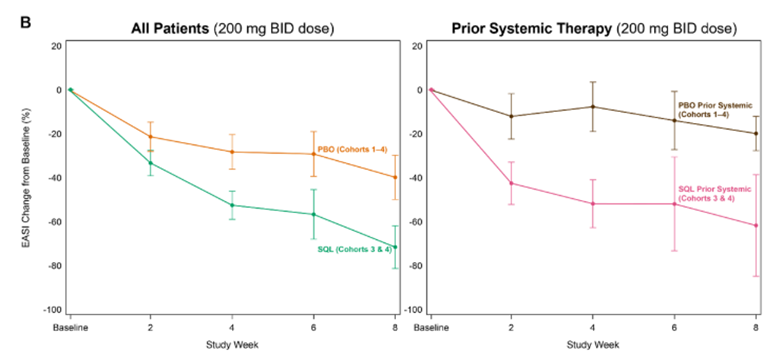
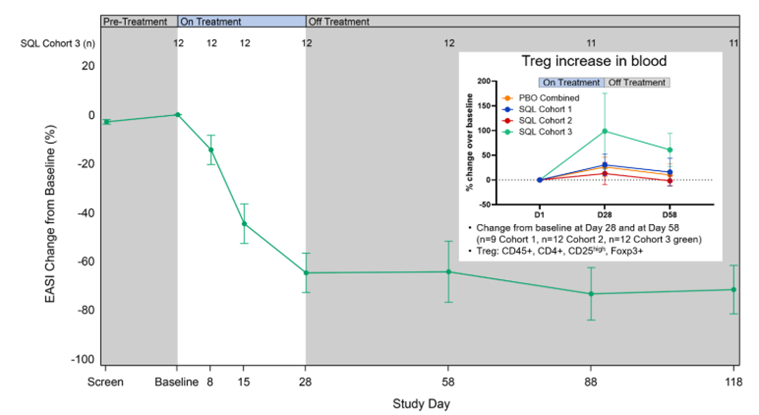
Figure 4 shows longer-term follow-up data from Cohort 3 patients, who also received 200 mg BID. The data demonstrate that EASI scores were maintained or improved for up to 3 months after the end of the treatment period, with increases in circulating Treg cells.Figure 4: Mean Percentage Reduction in EASI for Cohort 3 and Changes in Treg Cell Percentage for Cohorts 1–3
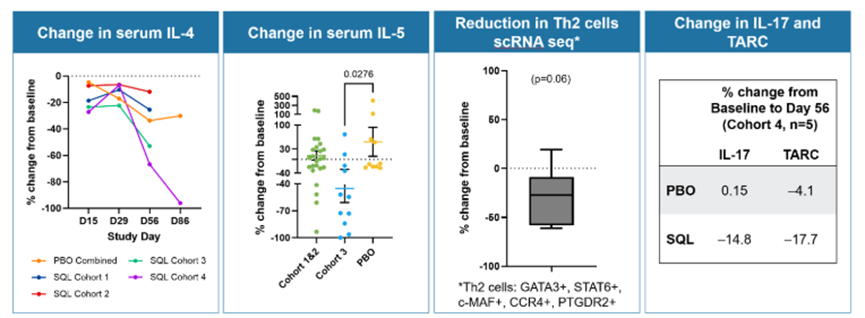
Biomarker data are shown in Figure 5. Reductions in serum IL-4 cytokine levels were observed in Cohorts 3 and 4, both during and after the treatment period, with a dose-dependent response; Cohort 4 patients showed the greatest IL-4 reduction through Day 86. Biomarker data from Cohorts 1–3 showed reductions in serum IL-5 cytokine levels compared with placebo, including dose-dependent responses, with Cohort 3 patients showing the greatest IL-5 reduction versus placebo. Reductions in serum IL-5 were observed as early as Day 8 of treatment. Serum IL-17 and TARC levels were also lower. Circulating Th2 cells (n=6, from Cohorts 1 and 2) were measured by single-cell RNA sequencing and were shown to decrease with treatment. As noted above, circulating Treg cells increased in Cohort 3 patients and were associated with extended treatment effects. These results are consistent with soquelitinib's demonstrated ability to block Th2 and Th17 cells and their secreted cytokines (e.g., IL-4, IL-5, IL-17), as well as its effects on Treg cells. These biomarker data indicate that soquelitinib induces immune system rebalancing involving Th1, Th2, Th17, and Treg cells.Figure 5: Biomarker Data: Changes in Serum IL-4, IL-5, IL-17, TARC, and Reduction in Th2 Cells
Safety Data for Cohort 4
As of January 15, 2026, no new safety signals were observed. Adverse events were reported in 41.7% of soquelitinib-treated patients and 50% of placebo patients; all were Grade 1–2 and did not result in any dose adjustments or interruptions. No serious or severe adverse events were reported. No significant laboratory abnormalities were identified.
For more information, please refer to the following link: corvuspharma.gcs-web.com/news-releases/
About Atopic Dermatitis
Atopic dermatitis, also known as eczema, is a chronic disease that causes skin inflammation, redness, scaling, blistering, and irritation. Current treatment options include topical therapies, oral medications, and systemic injectable biologic agents. Atopic dermatitis is frequently associated with other allergic conditions such as food allergies and asthma. Like asthma and allergies, atopic dermatitis involves Th2 lymphocytes, whose secreted cytokines drive inflammation. Preclinical studies have shown that soquelitinib inhibits cytokine production by Th2 lymphocytes. China has over 65 million AD patients, of whom nearly 28% have moderate-to-severe disease. The market size is expected to exceed $4 billion by 2030.
About Soquelitinib
Soquelitinib (CPI-818) is a clinical-stage, highly selective, oral small-molecule ITK inhibitor. ITK is primarily expressed in T cells and plays a role in the immune function of T cells and natural killer (NK) cells. Studies have shown that soquelitinib can influence T-cell differentiation, induce the production of Th1 helper cells, while blocking the development of Th2 and Th17 cells and their cytokine production. Th1 cells are essential for immunity against tumors, viral infections, and other infectious diseases. Th2 and Th17 helper T cells are involved in the pathogenesis of many autoimmune and allergic diseases. The company believes that inhibiting this specific molecular target in T cells may have therapeutic benefits for patients with cancers, including solid tumors, as well as those with autoimmune and allergic diseases. Recent studies have shown that ITK controls the switch between Th17 cells (pro-inflammatory) and regulatory T cells (anti-inflammatory). Inhibiting ITK promotes T-cell differentiation toward regulatory T cells, potentially suppressing autoimmune and inflammatory responses. In December 2024, a recent paper detailing the chemistry, enzymology, and biology of soquelitinib was published in npj Drug Discovery.
About Angel Pharmaceuticals
Angel Pharmaceuticals is a biopharmaceutical company focused on innovative therapies for immune modulation, committed to developing breakthrough drugs to improve the treatment of cancer, autoimmune diseases, and inflammatory disorders by targeting key signaling pathways in T and B cells. The company is co-invested by Beta Fund, Hisun Pharmaceuticals, Tigermed, and Puhua Investment, and has established a strategic partnership with Corvus Pharmaceuticals (CRVS) of the U.S. For more information, please visit www.angelpharma.com.